Showing posts with label Locomotives. Show all posts

Saturday, November 11, 2023

B-4R Build part 1

B-4R #605 Build

What started the C&S project

In the beginning of 2022, I had found the C&S Falcon branch through Jim Jones's "In the Shadow of the Rockies". I had initially dabbled in it with N scale, however that did not entirely go to plan, the lack of available small steam in that scale coupled with my fat fingers and Micro-trains couplers didn't go over very well. Around April was the TCA show in Denver and I had usually operated on the Colorado Rail Link layout in the past. I was on the verge of deciding what to do with these model plans when my friend Leighton mentioned he had some C&S steam for sale. Specifically it was a BLi 2-8-0 that had a cooked decoder, along with a short C&S passenger train. He gave a good price, so I ended up buying the 2-8-0, a BLi SD7 in CB&Q colors, and the short passenger train from him. 

At the time I wasn't entirely sure what era I was going for that early in my modeling of the C&S,  I knew the locomotive was a touch bit modern for the branch but the Burlington logo and C&S sublettering was actually something I was planning on doing at first. My initial plans were to model the branch as it was in its last few years of operation leading into 1935. These plans would change, but for the time being #638 was my only bit of C&S steam motive power. It would be joined in the Fall of 2022 by C&S #312, my first bachmann 4-6-0 rebuild.

#638 running on Rail Link at the April 2022 TCA show. Running behind it is the short passenger train I bought from Leighton.


#638 operating at the first ever Pikemasters Freemo setup in September of 2022.


Passing the water tower at Granger, October 2022 PMRA show in Pueblo. 

After the October 2022 PMRA show in Pueblo, I acquired a few other locomotives to operate with #312 that were much more era appropriate. This moved #638 to sort of back burner status. I displayed it on my shelves along with the Zephyr Connection passenger train as it was the only largish locomotive that could go with the passenger cars. 

At some point in Early 2023, I redecaled 638 as #605, a B-4R which the BLi model was much closer to. #605 also has the morbid curiosity bit of being the locomotive present at Ludlow. I still didn't know exactly what I was going to do outside of the decals, though I did 3d print a headlight and bracket for it. 


#605 at TCA in April 2023. Now sporting the re-decaling treatment. 

#605 on the Eastonville wye at TCA.

I had no definitive plan for #605 outside of occasional backup power use at shows until I saw a very nifty post by Tintic Range Railway on Facebook about a bachmann 2-8-0 that had been backdated  to represent an early 20th century locomotive. I had the inspiration at that point to do the same thing to #605. 

First was to come up with a plan, I figured to make a more accurate 605 I would need to do the following. 
    -Replace the cross compound with a single stage
    -Install some inserts to make the cab windows arch topped
    -Lower the running boards to bottom of cab height
    -install a wooden pilot 
    -build a tender insert to simulate wood extensions 
    -Install an older headlight. 
    -Swap the large tender watch hatch for a smaller one. 
    -Put a spoked pilot wheel on the front of the locomotive. 

I started with the basics; the air compressor before the PMRA show in October 2023

now with a single stage compressor. 

On the Falcon wye at the PMRA show. 

After the show I installed a wooden pilot. This took some trickery to get right, the coupler had to get swapped to a long shank to get the entire coupler head to clear the pilot when it was installed at the correct height on the pilot beam. I may come back and tweak this at some point, but for the time being, it's installed! I also found a spoked pilot axle in my stash of spares and installed it. 

Mocking up with the new pilot. Note spoked wheels too. 

Now with a painted pilot.

I need to swap the headlight over for a box headlight at some point to really sell the look, but just the pilot swap by itself really backdates the locomotive. At some point I'll go back through the list and get more work done on 605, but for the time being it really is looking the part. 

stay tuned for part 2 when the rest of the detailing work is completed. 


Friday, January 6, 2023

Modeling the Colorado and Southern C-3E class part 2


Modeling the Colorado and Southern C-3E class part 2

At the end of part 1, we had picked out our candidates for the C-3E class modeling, the bachmann ten wheeler coming out on top of the list for a starting point. Since that article was published, I've built 2 C-3E's and have a 3rd on the shelf of unlikely origin. 

#312, the first victim, er uh, candidate

The first C-3E started out life as one of the new bachmann 4-6-0's in the blue box. This particular one was a NYC ten wheeler I purchased from Amazon. Nothing too fancy here, just the basic model.
#312 started out as NYC 1238
A quick soaking of the old lettering in walthers solvaset left me with a locomotive sans decals. 

#312 now without decals next to K-2 ten wheeler #637

One of the first things I wanted to do was create the headlight on a bracket that the C-3E's all had. I first tried this with a PSC mason bogie bracket and wasn't that impressed.......
 
Mason bogie bracket, not quite what I'm looking for

While thinking on the headlight situation, I proceeded with the sound install. This locomotive received a soundtraxx megabass speaker in the tender along with a Loksound V5 Nano decoder. The speaker is so large I had to do quite a bit of milling on the tender frame and the nano barely fit back there with the speaker. My plan was (and still is) to place the keep alive under the coal load. I also added some coal board extensions at this time. These were done off memory of how I "thought" the boards should look, they never looked right to me and we'll come back to that shortly. At this time I also hit the model with a can of Walschaerts-be-gone (pat pending) and removed the valve gear. This would receive some tidying up before long, I ended up having to order new hardware for the main rods from bachmann, as the normal eccentric crank acts as a washer so a smaller screw can be used to hold everything together. Without the crank the main rod would just fall off, I ordered the larger hex head hardware for the 4-4-0's that don't have valve gear and it was a perfect fit!


312 on the bench with the coal boards and the lack of valve gear.

Around this time, I figured the best way to get the unique headlights for the C&S was to design and 3d print them. So out came 123D and I made up some headlights. I based 312s headlight on the real 312's round style headlight, at the same time I made a box headlight on the same bracket that some of the other locomotives had. I printed these headlights on my Elegoo mars resin 3d printer. They came out very nice, not 100% accurate, but they definitely are recognizable as C&S lights.  

the 3d printed headlight test fitting on the smokebox. Note I've also filed some of the extra valve gear detail off at this time.

With the headlight out of the way, now it was time to work on some other details. When I designed the headlight, I also attempted to design the unique cab that 312 received in the 20's but decided to hold off on that for now. I may revisit this at some point, but I decided having all the C-3E's in their late 1910's appearances would be easier to do. As they later started having odd drivers and tender swap galore occurring.  I also designed a tender bunker that would be a little more accurate than my attempts at building the coal boards. 

#312 posing next to #429 with the other style of headlight. #429 will be subject of it's own post at some point!

In September of 2022, the Pikemasters freemo club hosted its first ever setup at the TECO show in Colorado Springs. I managed to get 312 decaled up on one side with microscale C&S decals before the show and it ran around showing off a short mixed train for the show. 312 did just fine with the 6 car train on this layout, only issues arising were due to some bad trackwork on the return modules and the occasional mis-thrown switch. 

#312 crossing Mike Maline's bridge module.

#312 passing a small 4-4-0 on Mike Malines stock yard module. 


#312's bare side at the show. 

Parked on the spur at Granger on my module.

One thing that bugged me was the decals didn't look quite right. Nobody really makes a C&S decal for standard gauge locomotives pre-burlington lettering that I knew of. But It looked better with the lettering that without it, so a short time later I decaled the other side of the locomotive. 

Now decaled on both sides and with a painted headlight to boot!

I didn't have long to wait until another pikemasters setup bought #312 out to play again in October. This time 312's performance was hampered by a rather stiff grade on the modules, account of the ramp the layout was setup on. 312 spent a fair amount of time in front of 638 showing off my work until, it stopped working about halfway through day one of the show. I sidelined the locomotive on a spur to keep showing it off, at least I could still show the work. On a random chance later that day, I selected it again and it ran. Maybe it overheated or had a fluke? who knows, so I ran it. The next day, same problem, this time straight out the gate. What I was able to determine was there was either a bad connection or a bad spot on the commutator in the motor, as tapping around the motor on the outside of the shell would get it going again. I have heard mixed opinions on the new bachmann ten wheelers because of poor motor quality, so this could be the culprit. Either way, 312 was relegated to double heading for that show because of the grades. 

#312 double heading with #638 at the October TECO/PMRA show.

#312 on display after it stopped running, it ended up cycling in and out of this pocket until the end of the show.

Two more? #310 and #309

One thing I haven't mentioned at this point in the article is I acquired 2 more ten wheelers towards the end of Summer. In August, one of our former members at Pikemasters passed away and his family donated a bunch of items to the club. Included in this I found a brass Gem/Olympia Maryland and Pennsylvania ten wheeler. What I didn't know up until that point is the Bachmann ten wheeler is loosely based on the Ma&Pa ten wheeler. It was a basket case, with some valve gear missing, no drive train, and lots of loose parts and bodywork that needed to be soldered back on. I decided that this would become my #309. Since these photos I have removed the remaining valve gear on this one as well 

#309 next to #312 for comparison. 

Not long after the October show, I ordered a Bachmann Spectrum 4-6-0 from the original run of models. This one a UP model. This would become my #310 and would allow me to put to use some of the methods I had figured out with #312 to practice. First thing that occurred was to equip this one with a sugar cube speaker and Loksound V5 micro.

#309, 310 and 312 all together. 

One of the things I wanted to do at this point was change out the pilots on the locomotives, the Gem model had a a different small style of cow catcher with steps that was very close to what the real 309 had, so I decided this one could stay as is. The other 2 locomotives had bachmann's wide running board across the front, not exactly prototypical for the C&S (or for many roads for that matter....). So I searched for a solution. What I found was PSC #2962 brass pilots were pretty close to what the C-3E's had in some photos. I ordered 2 of these pilots and set about swapping out the pilots. 

310 mocking up one of the pilots. Looks like I'm going to have to remove that cast coupler pocket part......

#310 now equipped with the pilot and a kadee scale head coupler installed. I don't use trip pins, so this will couple to just about everything.


#312 with the new pilot. I think this actually made a decent addition of weight to this thing..

The pilots went on nicely, I had to remove the bachmann metal coupler box to make them fit and look right. I'll make a 3d printed draft gear part to sit here to look the part. I also painted the pilots at this time, and while I was at it, I painted the smokeboxes silver to match the prototype. 

Both locomotives now sporting new pilots and painted smokeboxes. A huge improvement!

One thing I mentioned earlier in the blog is that I wasn't happy with how the decals from microscale looked. I ordered sets from several manufacturers and found the ones from thinfilm were just about perfect! To top it off, they were actually silver, which is correct for the post 1908 era versus white. I destroyed the first set, turns out thinfilm decals don't like solvaset....... But I managed to salvage enough to finish #310. This was a HUGE improvement. I went back and removed the lettering off 312 and replaced it with thinfilm decals as well. 

310 with Thinfilm decals. This set I ruined with solvaset.

312 and 310 showing off both styles of decals, 310 with thinfilm, 312 with microscale. 

Both engines with the thinfilm decals

What's next?

Ok, so both engines look pretty good at this point. What's next? Well there are a few items on the list I'd like to knock out.

    -Redo the coal bunker on 312 and make one for 310. 
    -3d print a headlight for 310. 310 had a rather unique headlight I still need to design. 
    -Install keep alives in both 310 and 312 (insert your brand of capacitor if that's not your cup of tea)
    -backup lights for both engines, 310 had a rather large box headlight, 312 I don't have any clear shots of, but it seems to be a more modern round design. 
    -Install linkage for the unmodeled Stephenson valve gear on all 3 engines. 
    -Repower and repair #309, it needs some real TLC!
    -design and print a draft gear box to cosmetically complete the front of the locomotives. 
    -add crews and piping detail. 
    -add class lights

Whew, that's been a lot of work done in the article at this point! I have an offer from a friend to purchase one more of the spectrum 4-6-0's, which will become #317 in my fleet, this one will be equipped with the large pilot snow plow. 4 of the C-3E's allows me to pretty much accurately model the Falcon branch comfortably. 

Until next time, keep on modeling!

J. Patterson

Tuesday, August 9, 2022

Colorado and Southern steam locomotive roster

 This is the master roster list for the C&S I use for modeling purposes. It includes all the narrow gauge locomotives and Standard gauge locomotives that made it to the 1906 system classification. It does not include locomotives that made it to the C&S but were gone by 1906. If you have any information I have missed or would like to contribute some additional information, feel free to comment on this page. Be sure to check out the book "The Colorado Road" by F. Hol Jr. Wagner if you want even more information on this topic.

Reading the C&S Classification system

In 1906, the C&S started using a system used by the ICC (Interstate Commerce Commision) to classify the locomotives. A letter indicated the arrangement of wheels, and a number indicated number of driven axles. A second letter at the end was used to indicate different classes of that type, Eg, C-3E was a Ten Wheeler of the 5th type the railroad had. A number after the 2nd letter indicated a similar class that was added later. Eg. C-3H1 was a batch of locomotives ordered after C-3H that was similar but not identical. 

Letters and their meanings

"A" : No pilot or trailing wheels (Eg 0-4-0 or 0-6-0)

"B": One leading axle (Eg 2-6-0 or 2-8-0)

"C": Two leading axles (Eg 4-6-0, 4-4-0)

"D": One trailing axle (Eg 0-4-2, not used by the C&S)

"E": One leading axle, one trailing axle (Eg 2-8-2, 2-10-2)

"F": 2 leading axles, one trailing axle (Eg 4-6-2)

"G": 2 leading axles, 2 trailing axles (Eg 4-8-4, not used by the C&S)

Narrow Gauge
Eng Numbers Type Class cyl dri eng wt. trac ef BP Builder Built Notes
1 2-6-6T - 14x16 38" 75,000 10,806 150 Mason 2/80 Ex-DSP&P 24 "Buena Vista"
2 2-6-0 - 14x18 38" 53,600 13,535 150 Brooks 10/80 Ex-CC #11
3 2-6-0 - 14x18 38" 53,600 13,535 150 Brooks 6/81 Ex-CC #12
4-10 2-6-0 - 14x18 40" 61,300 11,201 150 Cooke 2/84 Rebuilt to class B-3C, Ex DSP&P
4-10 2-6-0 B-3C 15x18 40" 74,700 16,301 190 - - Rebuilt class
11-13 2-6-0 B-3A 14x18 40" 59,900 11,201 150 Cooke 2/84 Rebuilt with new cylinders 1900/1902; Ex DSP&P
11-13 2-6-0 B-3A 15x18 40" 59,900 12,909 150 - - Rebuilt class
14-16 2-6-0 - 15x18 38" 52,000 13,535 150 Brooks 1880/1881 All sold by 1902, Ex-CC
17-20 2-6-0 - 15x18 38" 60,300 13,535 150 Brooks 1882 Ex-DSP&P all sold by 1902
21-22 2-6-0 B-3B 15x18 38" 60,300 13,535 150 Brooks 1882 Ex-DSP&P, rebuilt 1910
21 2-6-0 B-3B 15x18 41" 60,300 13,770 160 - - post rebuild
22 2-6-0 B-3B 15x18 40" 60,300 13,770 160 - - post rebuild
30 2-8-0 B-4A 15x18 37" 61,748 13,901 150 Baldwin 1/80 sold 2/21, Ex-DSP&P
31-36 2-8-0 - 15x18 37" 61,748 13,901 150 Baldwin 1/80 All sold by 1902, Ex-DSP&P
37-55 2-8-0 B-4B 15x18 37" 62,900 13,463 145 Cooke 1883 Ex-DSP&P
56 2-8-0 B-4B 15x18 37" 63,250 13,463 145 Cooke 1883 Ex-DSP&P
57-62 2-8-0 B-4C 16x18 37" 71,030 15,816 150 Rh. Is. 1886 Ex-U&N;  #59 @ 73,600 pounds weight, #61 @ 71,200
63-70 2-8-0 B-4D 16x20 37" 76,000 17,574 150 Baldwin 1890 Ex-DL&G
71-73 2-8-0 B-4E 15 1/2 x 20 37" 80,500 19,848 180 Baldwin 1896 Ex-UPD&G
74-76 2-8-0 B-4F 16x20 37" 95,520 21,170 180 Brooks 1898 Ex-C&N
Standard Gauge
Eng Numbers Type Class cyl dri eng wt. trac ef BP Builder Built Notes
101 4-4-0 C-2G 17x24 62" 83,100 13,982 150 Rogers 12/81 Ex-D&NO #5, Dismantled 10/19
110 4-4-0 C-2B 17x24 64" 77,400 13,330 150 Rogers 1867 Ex-Union Pacific dismantled 1907
134, 135, 138 4-4-0 C-2L 17x24 61" 81,000 13,500 150 Cooke 1888 Ex-DT&FW
143 4-4-0 C-2S 18x26 62" 99,000 17,255 150 Schen. 1/89 Ex-CC
144-145 4-4-0 C-2F 18x24 69" 100,600 13,410 140 H&W 1867/1868 Ex-Union Pacific
200 0-6-0 A-3A 17x24 51" 82,800 17,272 150 Rh. Is. 1888 Ex-C&T/DT&FW
201-204 0-6-0 A-3B 17x24 51" 88,000 17,918 155 Baldwin 1890 Ex-UPD&G
205-211 0-6-0 A-3C 18x24 53" 94,000 18,633 150 Rogers 1887/1888 Ex-C&T/DT&FW
212-216 0-6-0 A-3D 18x24 53" 96,200 18,633 150 Cooke 1888 Ex-DT&G
220-224 0-6-0 A-3E 19x26 51" 133,000 28,200 180 Cooke 1906
223 0-6-0 A-3E 19x26 51" 142,700 31,200 180 - - post rebuild
225-231 0-6-0 A-3E1 19x26 51" 138,000 28,158 180 Schen. 1907
227-229/231 0-6-0 A-3E1 19x26 51" 143,000 31,200 180 - - Post Rebuild in 1927
232-236 0-6-0 A-3E2 20x26 51" 151,800 31,200 180 Baldwin 1910 232 boiler to rotary 99201
250-251 2-6-0 B-3H 17x24 56" 105,000 16,844 150 Rogers 1888 Ex-DT&G
252-254 2-6-0 B-3J 18x24 53" 96,200 18,633 150 Cooke 1888 Ex-DT&FW
252-254 2-6-0 B-3J 18x24 51" 96,200 19,410 150 - - Rebuilt 1907
300 4-6-0 C-3A 18x24 56" 93,400 17,635 150 Rogers 1887 Ex-C&T
309-319 4-6-0 C-3E 20x24 62" 131,200 21,380 180 Rh. Is. 1890 Ex-UPD&G
320-322 4-6-0 C-3G 20x26 63" 155,200 28,063 200 Rh. Is. 1900
323-326 4-6-0 C-3H 20x28 67" 169,500 29,636 210 Schen. 1902/1903
327-329 4-6-0 C-3H 20x28 67" 172,000 29,850 210 Brooks 1906
330-331 4-6-0 C-3H1 20x28 67" 187,450 29,850 210 Baldwin 1907
350-354 4-6-2 F-3A 25x28 69" 197,000 34,500 160 Baldwin 1910
370-372 4-6-2 F-3B 27x28 74" 269,200 42,200 180 Baldwin 1918 Ex-CB&Q, purchased 1919/1920
373-375 4-6-2 F-3C 27x28 69" 293,870 46,450 185 Baldwin 1922
400-401 2-8-0 B-4H 18x24 51" 107,000 19,364 150 Pitts. 1888 Franceville Mine Ex-DT&G power
402-411 2-8-0 B-4J 20x24 51" 122,000 26,350 165 Baldwin 1889 Ex-DT&FW
412-418 2-8-0 B-4K 20x24 51" 132,500 26,350 165 Rh. Is. 1890 Ex-DT&FW
419-421 2-8-0 B-4L 20X24 51" 138,300 26,350 165 Baldwin 1896 Ex-UPD&G
422-428 2-8-0 B-4M 20x26 51" 141,800 31,200 180 Baldwin 1897-1900 Ex-UPD&G
429 2-8-0 B-4N 19x26 51" 144,700 28,189 180 Cooke 1900
451-455 2-8-0 B-4P 21x28 56" 163,360 34,618 185 Rh. Is. 1900
520-531 2-8-0 B-4S 22 1/2 x 32 57" 206,100 45,980 190 Rh. Is. 1903 Built as tandem compounds, rebuilt to simple in 1920s
600-609 2-8-0 B-4R 22x28 57" 194,180 41,369 205 Rh. Is. 1901
610-624 2-8-0 B-4R 22x28 57 191,701 42,320 210 Richmond 1902
625-643 2-8-0 B-4R 22x28 57" 193,400 42,439 210 Brooks 1906
644-649 2-8-0 B-4R1 22x28 57" 194,250 40,400 200 Baldwin 1907
700-708 2-8-0 B-4Q1 21x28 57" 181,950 36,830 200 Baldwin 1907
800-804 2-8-2 E-4A 27x30 57" 266,550 56,550 170 Baldwin 1911
800-804 2-8-2 E-4A 26 1/2 x 30 57" 266,550 53,400 170 - - 1920's rebuild
804-809 2-8-2 O-4 27x63 63" 320,946 62,950 200 Baldwin 1919 Ex-CB&Q, purchased 1957, last class 1 steam locomotive purchase. 804 is 2nd 804. 808 only used as parts source
900-904 2-10-2 E-5A 30x32 60" 367,850 81,600 200 Baldwin 1915
905-909 2-10-2 E-5B 30x32 63" 380,000 77,710 200 Baldwin 1919 USRA design
910-914 2-10-2 E-5C 30x32 60" 404,070 83,000 200 Baldwin 1922

Sunday, July 31, 2022

Pike sized passenger trains; Colorado & Southerns Zephyr Connection

The Zephyr Connection; Pike sized train

So here's an article that's been done just a few times by others over time. Pike sized passenger trains is a popular topic for people wanting to model passenger trains but don't have the space to run the long full length name trains. 

The name originates from an article written by Andy Sperandeo for Model Railroader in 1987, this topic has become a popular topic for modelers as there are quite a few smaller passenger trains out there that are just as interesting as their larger, more well known contemporaries.

While not seen in service on the Falcon branch, I bought a pre-done C&S passenger train from a friend along with my BLi #638, so I decided to pursue modeling this train. Later I would find out about the Pioneer Zephyr and a connection it had to the Falcon branch, so that was a given I'd have to do as well. 

The real Zephyr Connection

The prototype train known as the "Zephyr Connection" started out life as train #31-32, the Denver to Wendover, Wyoming train. In 1929, #31-32 became the Denver-Cheyenne Local. This train operated typically in a basic consist consisting of a baggage, RPO, and coach. In 1936, the CB&Q rebuilt a former SP&S solarium-lounge into a solarium-parlor car and placed it into service with the #31-32. Numbered #220, the solarium was named "Denver" on the right side and "Cheyenne" on the left side. This solarium continued in service until WWII, when it was converted to a chair car and returned to the Q. 

At some point in the 30's, the train received the name "Zephyr Connection" and in October of 1949, the famed Pioneer Zephyr took over the duties of the Denver-Cheyenne run. However this would be short lived as on April 29th, 1950, the Pioneer Zephyr collided with a water truck in Longmont and was heavily damaged. Fireman Dan Grinstead was seriously injured in the collision and never returned to work. The damaged zephyr was returned to the CB&Q shops in Aurora and rebuilt, never to return to the Zephyr Connection. 
Photo from the Longmontian

Afterwards, the train continued on as a standard locomotive hauled train, now using the Burlington's E7's in pool service out of Denver. It was discontinued outright on February 28th, 1951. 

Consists

Here is a small selection of basic consists I've been able to identify from photos
    
        1937, date unknown
        350 class pacific Unk number
        RPO-Baggage
        Steel Combine
        #220 Solarium-Parlor

        1936, date unknown, Otto Perry photo
        CB&Q Pacific #2911
        RPO-Baggage
        Steel Combine
        #220 Solarium-Parlor
    
        1942, date unknown, Otto Perry photo
        Colorado & Southern #350 4-6-2
        RPO-Baggage
        Coach
        Coach

        1941, date unknown, Otto Perry photo
        Colorado & Southern #350 4-6-2
        RPO-Baggage
        Coach

        1939, date unknown, Otto Perry photo
        Colorado & Southern #350 4-6-2
        RPO-Baggage
        Steel Combine
        Coach
        #220 Solarium Parlor
        
        1951, date unknown, Otto Perry photo 
        CB&Q E7 #9936-B
        Baggage
        RPO
        Coach

        1951, date unknown, Otto Perry photo 
        CB&Q E7 #9934-A
        Baggage
        RPO
        Coach
        

In general, it seems the train operated until WWII with an RPO-Baggage, Combine, and the Solarium Parlor. I see occasional photos where an extra coach or two is added, and sometimes even without the combine. 

Post WWII, the train has lost #220 and operates with two head end cars, and whatever coaches are needed. Some photos show the train down to just a baggage-rpo and coach. 

In the last year of operation with the E7, the consist seems pretty consistent from what I've seen, with the 2 head end cars and a coach.

Modeling the Zephyr Connection #31/32

This part is going to seem a little disappointing to those used to the normal passenger car specific listings and options usually associated with modeling passenger trains. To my knowledge, there is no book on Colorado & Southern passenger cars, nor did the CB&Q passenger book I looked at include any information on the fleet of passengers cars. Of course, the Texas Zephyr has quite a bit of information available, and the C&S narrow gauge is well documented. However unless somebody knows another source, I do not have detailed listings of the C&S standard gauge passenger cars, so this is going to be a generalization of what is available and what looks similar to photographs. One might be able to cross reference CB&Q passenger car roster photos to find cars of similar/identical construction. My train was already created by another modeler (Leighton) when I purchased it, but he has done a good job picking cars that are pretty accurate. 


Baggage Cars

For my model of the baggage car, I have a walthers ACF Baggage, which while not a dead on match for the photos I've seen, it is similar to a photo of C&S #220 (not the Solarium, a baggage car). This is the number I've chosen to use for the train (for comical effect too, wait for it)
C&S 220


RPO

My RPO is a model done by a friend of mine, Leighton. He had done up a walthers heavyweight RPO as C&S #254, the RPO preserved today at the Colorado Railroad Museum. I'm keeping this one as is, it's pretty close and has a local connection with the museum. 

C&S 254

Coach

The best match I've been able to find to the Burlington Coaches is the Atlas/Branchline single window coaches. I've seen some people also do a very nice job with the athearn bluebox shorties in dressing them up to be good stand ins!
Atlas/Branchline single window car, to be relettered to C&S

Athearn Bluebox cars done up very nicely.

Solarium

So this car is a LONG stretch to be modeled by the walthers solarium car, but it's about the only option unless you dig into brass or scratchbuilding. I bought the former trainset from Leighton (RPO, Baggage, coach) in March 2022 and was going to roll with just those cars until I found pictures of the solarium. I mean, why not, it's a very cool and unique car! I happened to mention to him again that I was contemplating finding a walthers solarium when he stated he not only had one, it was for sale. So in the end, all 4 passenger cars came from Leighton to start the Zephyr Connection. My end goal with this car is to modify the interior to be more a lounge than the sleeper accommodation it has now. I have a nice photo showing the drumhead on the car with the "zephyr connection" text, so creating the drumhead is on my list. This car will also carry the #220 number, same as the baggage car, just to see how many people notice. I have managed to determine what letters I need to steal from other car names on the decal sheet to do Denver and Cheyenne on each side as well. 
Solarium #220, to be relettered at this point


Motive Power

Motive power for the train is going to be a bit of a mixed bag of trying to find models. Primarily in the steam era, the C&S's Pacifics did most of the hauling of the train, I have one photo that seems to show one of the large ten wheelers (class C-3H?) on point. In the diesel era the E7's seemed to be the predominate power.

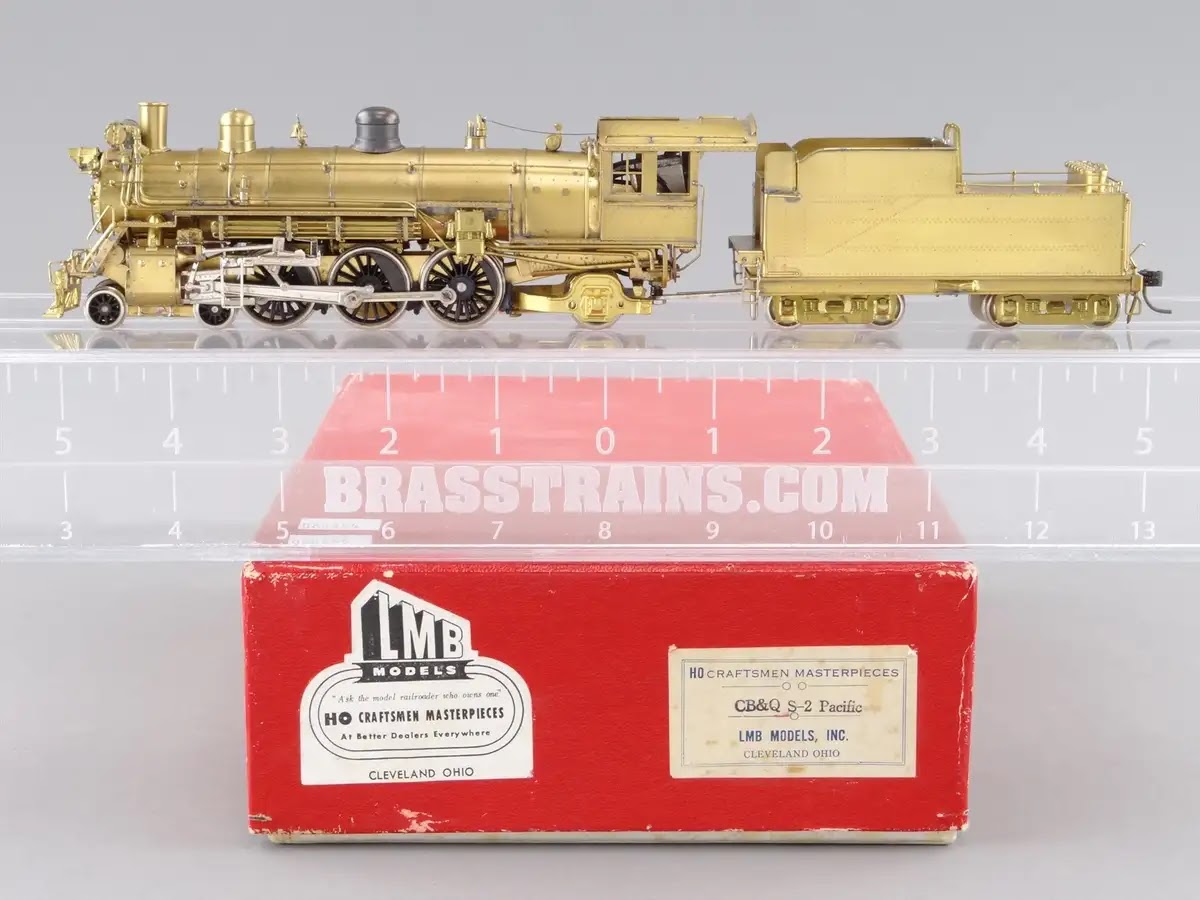
LMB Models S2 Pacific    

LMB models has done a model of a CB&Q S2 pacific that would be a good C&S 370 class pacific. These aren't expensive but are fairly rare to come across. One photo of #31/32 does show CB&Q #2911 on the point of the train, which is an actual S-2 class pacific. One caveat to kitbashing one of these from another pacific is the oddball high speed trucks under the tender, more at home in headend equipment than tenders!  
        
LMB models S-2 pacific, Brasstrains.com photo

Varney/Bowser Casey Jones ten wheeler

As mentioned in the above text, in one photo, it does look like one of the C&S's large ten wheelers (C-3H) was on point of the train, however I cannot confirm this. If one was wanting to make a C-3H in HO scale, a Varney/Bower ten wheeler would be a good starting point to build one of these larger ten wheelers. A new headlight, some tender tweaks, and it would be a good stand in. 


EMD E7

There are several options to do the E7 in HO scale. Broadway Limited, Proto 2000, Walthers, Bachmann (if you're really desperate), and several varieties of brass. My choice in this particular case would be one of the walthers proto 2000 models, they're decently detailed, available cheap and easily, and can be really good runners. The BLi is a good choice as well, the mechanism is quite nice, and while the electronics can be a real let down, that's a pretty easy fix. This particular choice in motive power technically eliminates the solarium from the options list. 

Proto 2000 E7


Pioneer Zephyr

Ok, this was the part everyone was waiting for. Con-cor has done an excellent Pioneer Zephyr in HO scale and N scale. The lights are nuclear out of the box and will need to be toned down, but you need to get in there to put figures in the coaches anyway! I installed a loksound select micro decoder in mine. For the time period the Pioneer Zephyr ran on the zephyr connection it had the dual headlight arrangement (anyone want to trade a dual headlight for a single headlight train?) with the gyralight up top. This one is probably the easiest C&S passenger train to create as you can really just take it out of the box and it's correct, the C&S did not reletter anything during it's time in service. The train did by that point have the 4th car added into the consist as well. 
My Pioneer Zephyr

Interesting side note here. While my modeling primarily focuses on the Falcon Branch, I did spur out a bit to do #31/32. However the Pioneer Zephyr does have a connection with the Falcon branch, sorta. When the Pioneer Zephyr was performing its tour of the US, it was run to Connors and displayed there in 1936 for the opening of Buchtel Blvd. So the Pioneer Zephyr does have a small connection to the Falcon Branch, however brief. 


Improving the Tractive effort of small steam locomotives

 The small locomotive curse  I'm sure a lot of us have been here. You bought a new engine for your model railroad, you put it out on the...